
- Start with fragrance-free, dye-free, water-based formulas and test a little first.
- Evidence that glycerin causes yeast infections is weak; it is a precaution, not a proven risk.
- WHO says nonoxynol-9 is not recommended and advises avoiding polyquaternium-15.
- Parabens are common preservatives that irritate some people; FDA has no information showing harm to health in cosmetics.
- Persistent burning or itching is a reason to stop and see a clinician.
If you have ever had a burning, itchy or tingly reaction to a lubricant, you are not imagining it. Delicate skin reacts to some ingredients more than others, and labels do not always make it easy to know which. Finding a lube for sensitive skin mostly comes down to reading a few key ingredients.
This guide walks through the ingredients that come up most often, separates well-supported concerns from theoretical ones, and gives you a short shopping routine. It is general information, not a diagnosis.
Lube for sensitive skin: the simple rules
You can avoid most irritation with a few habits:
- Choose unscented and unflavored formulas. Fragrance and flavoring are common irritants.
- Skip warming, tingling or cooling products if you are reactive.
- Pick a short ingredient list so you can identify what bothers you.
- Patch-test on the inner arm, then a small amount in the area of use.
- Keep a note of any product that causes a reaction, so you can find the common ingredient.
Our sensitive skin category collects fragrance-free and glycerin-free options, and how to choose a lubricant covers the bases.
Ingredient by ingredient
This table summarises the main ingredients to avoid and what research and WHO guidance say. A pH balanced formula, around 4.5 for vaginal use in WHO's 2012 advice, is also worth looking for. Where evidence is weak, we say so.
| Ingredient | Concern | Evidence | Action |
|---|---|---|---|
| Glycerin / glycerol | Raises osmolality; may feed yeast | ~ Theoretical; no direct clinical link found | ~ Try glycerin-free if you get thrush |
| Propylene glycol | Raises osmolality; can irritate | ~ WHO limit of 8.3% w/w | ~ Check if reactive |
| Parabens | Preservative; can sensitise some people | ~ FDA: no information showing health effect in cosmetics | ~ Choose paraben-free if you react |
| Nonoxynol-9 | Irritant; higher HIV incidence in one trial | ✓ WHO advises against | ✗ Avoid |
| Polyquaternium-15 | Enhanced HIV-1 replication in vitro | ✓ WHO advises avoiding | ✗ Avoid |
| Chlorhexidine | Preservative; K-Y Jelly toxic to Lactobacillus in vitro | ~ Not isolated as cause | ~ Check if you get BV |
| Fragrance, flavor, warming agents | Common irritants | ~ General dermatology advice | ✗ Avoid if sensitive |
Source: WHO/UNFPA/FHI360 2012; FDA; Dezzutti 2012
What the research says about glycerin and oils
Glycerin is the ingredient people ask about most. A Mayo Clinic OB-GYN has said it can break down into sugars and might encourage yeast infections, but we found no clinical study directly linking glycerin lubricants to candidiasis. It is a reasonable reason to try a glycerin-free lube if you are prone to thrush, not a proven risk. Glycerin does raise osmolality, which is a separate concern covered in our osmolality guide.
Oils and petroleum jelly are a different story. In a Los Angeles cohort of 141 women who used intravaginal products, oil use was linked with Candida colonisation (44.4% vs 5%), and petroleum jelly users had 2.2 times the risk of bacterial vaginosis. It was a small observational study, so treat it as a signal.
Candida colonisation by oil use
Women with intravaginal practices (LA cohort, n = 141)
A calm shopping routine
Reactions are frustrating because it is hard to know which of a dozen ingredients is responsible. A simple routine makes detective work easier:
- Pick one new product at a time and avoid starting two together.
- Read the full ingredient list and photograph it, so you can compare if a reaction occurs.
- Test on the inner forearm for a day, then use a small amount in the area of use.
- If your tissue is sore, delay sex or use a plain moisturizer instead until it settles.
- If you react, compare the list against a product you tolerated well. Ingredients found only in the product that bothered you are the first suspects.
It also helps to rinse after use with plain water and avoid scented washes. Our use and clean-up guide has more on gentle clean-up. People with eczema, contact allergies or a history of recurrent infections should ask a clinician which ingredients to avoid.
Remember too that the bases behave differently on skin. Silicone lubricants are single-ingredient or short-list formulas that many sensitive people tolerate, and they contain no water, so they need little or no preservative. Our silicone category includes products such as Durex Silicone, described as single-ingredient, and Uberlube, described as non-sticky with vitamin E.
Products with short or gentle ingredient lists
From the makers' own descriptions:
- Sliquid H2O is made with plant cellulose instead of glycerin, and the maker says it is free of glycerin, glycol, parabens, PEG, propylene glycol, sorbitol and sulfates.
- Good Clean Love BioNude is described as hypoallergenic and made for people sensitive to certain natural ingredients such as aloe vera.
- pjur med Sensitive is described as neutral, water-based and free of glycerin, parabens and preservatives.
- Astroglide Ultra Gentle is described as made without glycerin, parabens, fragrances or alcohol.
- Trojan H2O Sensitive Touch is described as fragrance and dye free with aloe and vitamin E.
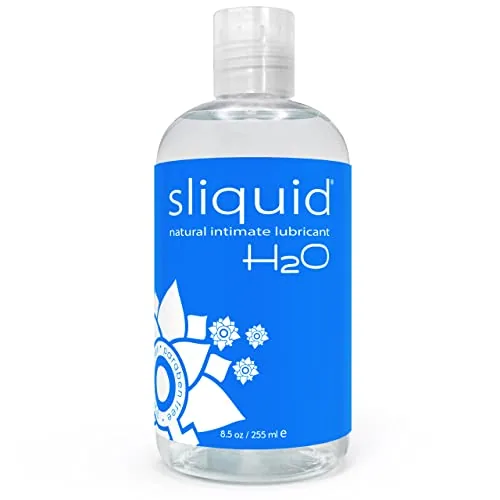
Sliquid H2O Water-Based Lube, 8.5 oz
- Glycerin & paraben free
- Fragrance free & vegan
- Toy & condom compatible
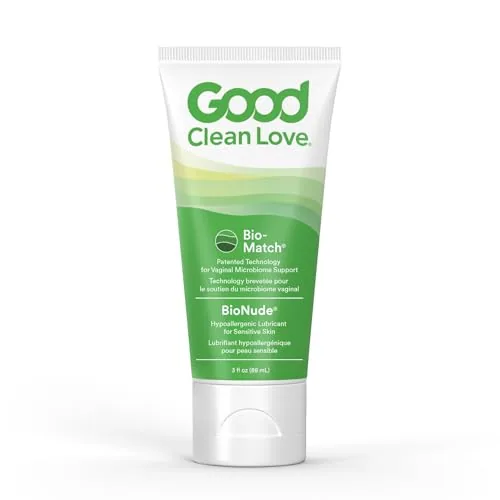
Good Clean Love BioNude Ultra Sensitive, 3 oz
- Glycerin & paraben free
- Unscented, unflavored
- Hypoallergenic
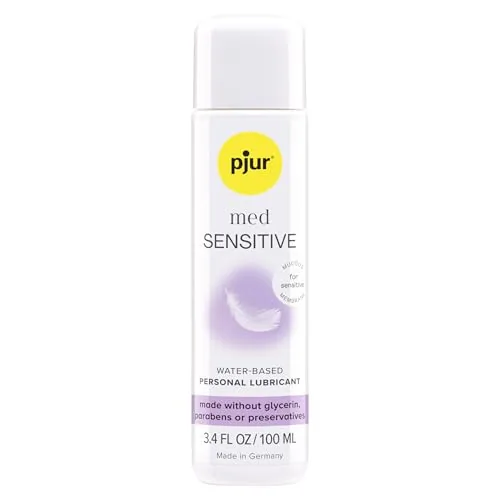
pjur med Sensitive Water-Based Lube, 3.4 oz
- Glycerin & paraben free
- No preservatives
- For sensitive skin
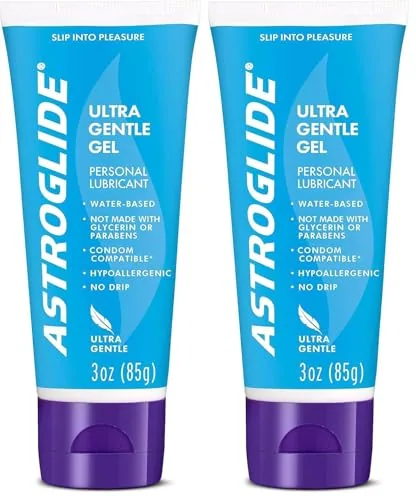
Astroglide Ultra Gentle Gel Lube, 3 oz (2-pack)
- No glycerin or parabens
- Hypoallergenic
- Two-pack
Remember that an ingredient someone is sensitive to can be a plant extract, not just a chemical. If you react to aloe, avoid aloe-based formulas, and see natural and aloe lubricants for more.
When a reaction happens
If you notice burning, swelling, hives or severe itching, stop using the product, wash gently with plain water and speak to a clinician or pharmacist if it does not settle quickly. Do not treat repeated thrush or BV by changing lube alone. Both are worth getting diagnosed.
If dryness is the reason you are reaching for lubricant, our dryness guide explains moisturizers and when to ask about other treatments.
Questions
Is glycerin bad in lube?
Not proven. It raises osmolality and a clinician has suggested it might encourage yeast, but no direct clinical study links glycerin lubricants to infection. Try glycerin-free if you often get thrush.
Are parabens in lube dangerous?
FDA says it has no information showing parabens in cosmetics affect human health, but WHO notes they can irritate or sensitise some people. Choose paraben-free if you react.
What is the best lube for sensitive skin?
Start with a fragrance-free, dye-free, water-based formula with a short ingredient list, and patch-test before use.
Should I avoid spermicidal lube?
Yes. WHO says nonoxynol-9 has significant irritant effects and its use is not recommended.
Is there such a thing as hypoallergenic lube?
Some makers describe their formulas as hypoallergenic, but the word does not guarantee you will not react. Read the ingredient list for fragrance, flavoring, parabens and glycerin, and patch-test first.